|
Guinea Pigs Standard For The Breed(s)
Below I have the Standard of Perfection, or Standard of the Breed for Cavies/Guinea Pigs, as per the American Cavy Breeders Association. You will notice that Show Guinea Pigs are probably larger than any you have seen before. Their shape is more like a Potato and their noses more 'blunt'. They are absolutely gorgeous and the Standard for each Breed is what Breeders should be striving for.
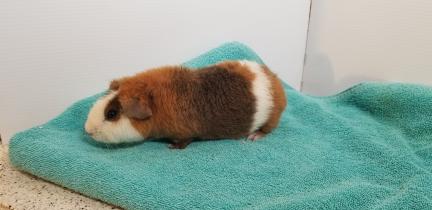
~YES, *MORE* PHOTOS ARE COMING!~
I am working to find photos, many of these are of my own GP, and might not be show quality, but does represent the Breed well enough a person can see what that Breed Looks Like. Such as this photo of my darling Teddy Boar, he is not perfect, but you Can See his Teddy Coat well.
The contents of this page for Guinea Pigs Standard For The Breed(s) is still under construction. It is going to take me a while to type out each Standard, but I wanted, at least, an overview of each breed, ARBA approved, British Cavy Council, and some Not yet and may never be approved by Clubs, up and going on *THIS* website. Please check back often. Yes, I hope to add photos soon.
If you notice a Breed I have not covered, PLEASE Contact me. If you have photos of that Breed, that I can use here, that would be very helpful too.
There are 13 Breeds of Cavies (Guinea Pigs) that are sanctioned by the American Cavy Breeders Association (ACBA)
I have these, Standard for Perfection or Standard for the Breeds used for The American Rabbit Breeders Association, ARBA, as well as The American Cavy Breeders Association, ACBA. These Associations are also know as "The Mother Clubs for Rabbits and or Cavies (Guinea Pigs) in the USA, as well as Other Breeds list below.
Abyssinian - Coat is short, harsh, and wiry in texture. The rough hair spreads out from a tiny center forming distinct rosettes. There should be one rosette on each shoulder, two on each side of the saddle,
one on each hip, and one on each side of the rump, for a total of at least 10 rosettes. Other terms to describe this unique coat are: ruff/collar, rump ridge, mane, back ridge.
Standard of Perfection for Abyssinian Cavy - Show Type
ABYSSINIAN
GROUPS: SELF—AGOUTI—SOLID—MARKED
SCHEDULE OF POINTS
TYPE 10
COAT 65
Texture 10
Rosettes 25
Ridges 25
Head Furnishings 5
COLOR 15
CONDITION 10
TOTAL POINTS 100
TO BE ENTERED AND SHOWN IN SIX CLASSIFICATIONS:
1. SELF—to include: Beige, Black, Chocolate, Cream, Lilac, Red,
Red-Eyed Orange, and White.
2. AGOUTI—to include: Dilute Agouti, Golden Agouti and Silver
Agouti.
3, BRINDLE
4. ROAN
5. ANY OTHER SOLID—to include: Dilute Solid, Golden Solid and
Silver Solid.
6. MARKED—to include: Broken Color, Tortoise Shell, Dalmatian,
Dutch, Himalayan, and Tortoise Shell & White.
NOTE: In order to allow the rosettes and ridges to stand erect, the animal should be lifted and handled from underneath as much as possible.
The Abyssinian likes to move, and probably can best be judged if allowed to do so. Posing an Abyssinian may present difficulties. Ridgesare to stand erect; therefore, the judge is encouraged to set rosettes and ridges up to the best of their advantage after the initial handling.
To pose an Abyssinian, place a thumb on the shoulders just in front of the collar to control the animal and allow the rosettes and ridges to be seen clearly. Hindquarters can be gently lifted from underneath to allow a better view of the hip and rump rosettes.
The coat should be stroked with the thumb and forefinger from the center of the rosettes toward the ridges to feel texture, and then gently patted with the palm of the hand, to determine the firmness of the ridges.
TYPE—Points 10: Abyssinians are to have a medium body length, and plenty of depth to the shoulders and hindquarters. The limbs are to be well formed, and closely set without narrowness. The head is to be wide with fair length. The ears are to match the variety description, be shapely and slightly drooping, but not fallen.
EYES—The eyes are to be large, full, bright, and match the variety description.
COAT—Points 65: (Texture 10; Rosettes 25; Ridges 25; Head Furnishings 5). The coat is to be dense, and of sufficient length to form deep rosettes and ridges, but not to exceed 1.5 inches in length.
Texture—Points 10: The coat is to be harsh in texture, having a firm feeling when the ridges are patted with the palm of the hand. Allowfor softer texture in juniors.
Rosettes—Points 25: Each rosette should rise and radiate evenly from a pinpoint center. Rosettes should be placed as follows: one on each shoulder (2), four saddle, two hip, and two rump rosettes. Saddle rosettes should be placed two on each side, in line with one another, and equidistant between the collar and the rump ridge. Shoulder rosettes should be placed just above each foreleg, below the
collar.
Hip rosettes should be placed on each hip, behind the rump ridge, and radiate evenly to create a round appearance.
Rump rosettes should be placed high enough on the rump, and far enough apart on each side of the spine to prevent guttering and form an erect ridge around each rosette.
Other rosettes may be present on the nose, belly, and high on the shoulder, in front of the collar. However, any extra rosettes or parts of rosettes, which interfere with the specified pattern of rosettes and ridges, should be faulted.
Faults —Double, split, swirled, guttered, misplaced and/or open centered rosettes; extra rosettes or parts of rosettes which interrupt the specified pattern.
Ridges—Points 25: Each rosette should be separated from the next rosette by an erect ridge of hair. There should be clear, straight ridges
running around the shoulders (collar), down the spine (back ridge), across the hips (rump ridge), and separating each saddle, hip, and rump rosette. The coat should rise sharply from the center of the rosettes to the top of the ridges without any flattening.
Faults—Flatness of coat over shoulders or back; crooked ridges; soft texture; coat too short.
Disqualifications from Competition—Coat over 1 % inches in length; less than eight clear rosettes (4 saddle, 2 hip, 2 rump - a double rosette does not count twice toward the total); satin sheen—not to be confused with the natural luster of some colors.
Head Furnishings— Points 5: The coat on the head of an Abyssinian should form a well-developed mustache around the nose and an erect mane rising between the ears to the collar.
COLOR —Points 15: The color is to match the variety description. In marked varieties color points are to be divided equally— ¥% the points to color quality and 4 the points to markings.
CONDITION - Points 10: Per ARBA definition.
Abyssinian Satin – Has the same distinct coat of rosettes and ridges as the Abyssinian, but the coat should have a glowing satin sheen. The hair shafts are hollow, and each shaft should be through the entire coat, giving the high shine when light hits it.
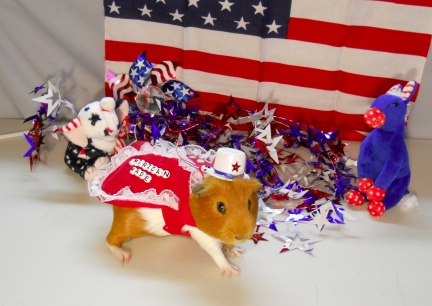
American – Coat is short, smooth and silky. Has a Roman nose with ears that are shapely and slightly 'drooping' but not fallen.
American Guinea Pigs are where the Nick Name, "Hairy Potato" comes from. When bred correctly, they should look much like a Great Big Potato in shape.
I know this is not the typical Breed Standard Photo, but I hope it made you smile.
Standard coming very soon
American Stain – Similar to the American in appearance, however, the coat should be fine and dense,with a silky, soft texture with a high sheen. The hair shafts are hollow, and each hair shaft should be through the entire coat, giving the high shine when light hits it.
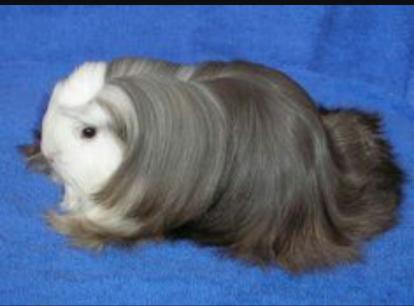
Coronet – A long-haired breed with a normal coat. Coat grows evenly from the back and sides, with the coronet or rosette radiating evenly from a clearly defined pinpoint center of its head. The rear
portion of the coronet blends into the mane with the front portion drooping over the eyes. Is not recognized by ACBA in Satin.
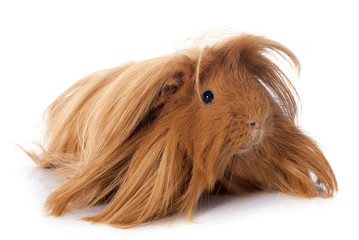
Peruvian – Coat grows from a part going down the cavy's entire back, with the hair growing over the head and down the back and even from short distance, it is difficult to tell the front from the back of the
animal.
This photo is NOT a photo of a Show Guinea Pig. This is a typical Peruvian Guinea Pig. I wanted the photo to give people an idea of the type a Peruvian really is when they go to purchase one without going to a Show Breeder.
Peruvian Satin – Has the same physical characteristics as the normal Peruvian, except there must be a lustrous sheen over the entire coat. The texture of the coat is also much silkier. The hair shafts are hollow, and each shaft should be through the entire coat, giving the high shine when light hits it.
Silkie – Long-haired breed with a broad head and a short Roman nose. The side and rear sweeps grow the same as on the Peruvian, however, the mane grows back from the head and over the back and therefore should not be parted.
Silkie Satin – Has the same physical characteristics as the normal Silkie, except for a lustrous sheen over the entire coat with a much silkier texture. The hair shafts are hollow, and each shaft should be through the entire coat, giving the high shine when light hits it.
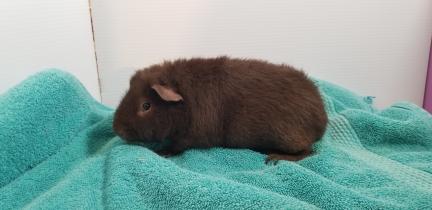
Teddy – The coat is to be extremely dense and “kinky,” with an ideal length of 3/4”. There are two separate textures in the Teddy's coat, with one being plush and the other harsh.
Teddy Satin – Similar to the Teddy in appearance, however, the coat is to have a luxurious and resilient texture. The hair shafts should hollow, reflecting the light to a high shine.
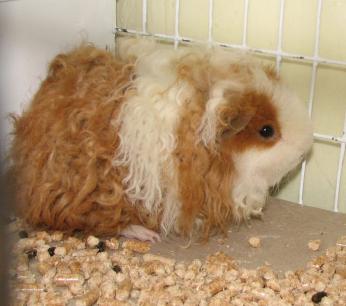
Texel – A long-haired breed, with a coat that grows corkscrews or curls (ringlets) 1/8”-3/4” in diameter. The coat should be soft, dense, and springy to the touch. The head resembles that of a Teddy and is the
only breed with a compact, cobby body. This Breed is not recognized as a Breed in a Satin.
White Crested – The standard is the same as the American Cavy except it must have a white crest. The crest is a rosette centered on a running line from the tip of the nose to the center of the ears, there is to
be no white anywhere else on the body. Is not recognized as a Breed by ACBA in a Satin.
OTHER GUINEA PIG BREEDS
These are Breeds of Cavies NOT approved by ARBA and or ACBA, some may be in the process of working on getting approved, others may not.
Some of these breeds are approved for Showing in other Countries.
If you know of a Breed of Cavy I did not include in this list, on this page, please contact me, my email is listed below. If I do not reply in 24 hours, I probably did not get your email, PLEASE send again. Thanks!~
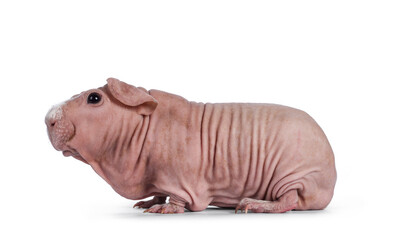
Baldwin - This Breed is a much like a Skinny Pig. The biggest difference is genetics. The Baldwin is born with hair and looses it either right away or with in a few weeks. As I understand it, the Baldwin is usually, not always, closer to hairless than Skinny Pigs... and OF COURSE this matters who is breeding and how.
People always say that the Baldwins look like tiny Hippopotamus. Completely Hairless in GPs is still not an easy animal to find. After you see one in the color black, you will be singing, "I want a Hippopotamus for Christmas.....".
Proposed Baldwin Standard*
Group 1: Solids Group 2: Marked
Type: 15
Ears: 20
Eyes: 10
Condition: 10
Texture: 15
Color: 5
Wrinkles/Folds: 25
Total Points: 100
Type: Points 15: Baldwins are to have medium body length with plenty of depth to shoulders and hindquarters. Head is to be wide with fair length.
Note: Juniors and Intermediates are not to be faulted for potty belly appearance.
Ears: Points 20: Ears should be shapely and slightly drooping but not fallen, large and free of hair giving a rose petal effect.
Eyes: Points 10: Large, full & bright. Pink, ruby cast, dark, black, red or blue.
Condition: Points 10: Firm body condition.
Texture: Points 15: The Baldwin is to have the texture of rubber, feeling like rubber.
Skin is to be healthy in appearance.
Wrinkles/Folds: Points 25: The Baldwin is to have wrinkles and folds on the head, shoulders and legs. The head wrinkles are to have a line down the center with wrinkles forming around it. Shoulder wrinkles are deep, rump smooth.
Group 1- Solids: Solids to be judged on evenness of color, allowing for darkened points as exposed skin normally is darker than skin which is covered by hair.
Group 2- Marked: Dalmatian, Himalayan, Broken, Dutch. Marking to match marked description in standard.
Black Devils or Devils or Vampire
These lovely Black, very Black, Guinea Pigs with Ruby or Pink eyes can be called by each of these names. It depends on who you talk to what they call them.
The breed is being developed in the UK by the Name Black Devils.
I hope to have a photo soon.
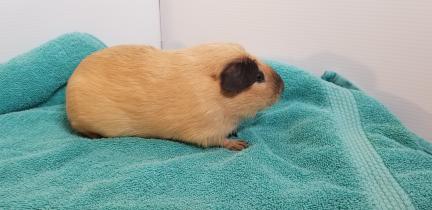
Californian also called by Nick Name Cali - These markings are not just beautiful, they are very popular right now (2026). This is not, however, a Breed in the USA and is considered Markings,mostly found on American Cavies. However in the UK, it is a Breed. Here is the UK Standard for Perfection:
Promoted to Full Standard, 1st January 2024
Standard of points:
Points:
Head, Eyes & Ears, Head to be of good size, bold and broad, with a gently curving profile. 10
Muzzle to be of good width and rounded at the nostrils.
Eyes to be large, bright and bold and set with good width between.
Ears to be large and drooping, parallel to the ground and set with good width between.
Body Shape: To have short, cobby body of good width, with deep, broad shoulders. 10
To be fit and of good substance, with plenty of firm flesh.
To have good size appropriate to age.
Markings: of which To consist of even, sharply defined dark points on face, ears and feet with clear demarcation from the body color. 50
Smut.To be prominent, pear-shaped, and carried well up between, but not over, the eyes. (25)
To be sharply defined and even, and intensely colored black or rich milk chocolate.
Ears: To be intensely colored black or rich milk chocolate, dense to the base (5)
Feet: To be even and intensely colored black or rich milk chocolate; sharply defined, with color carried well up the legs to just beyond the hock joint, also covering the nails and pads. (20)
Color: To correspond to ESCC Red, DE Golden, Buff, DE Cream or DE White, with similar eye color. As free from body pigment as possible. 25
Coat: To be soft and silky, clean and groomed free of guard hairs. 5
Description of Colors
Californians may be exhibited in the following colors:
ESCC Red, DE Golden, Buff, DE Cream or DE White (with corresponding eye color), and with either Black (black) or Chocolate (rich milk chocolate) points.
NB: Pink eyed Californians do not have a Full Standard.
Guidance notes:
The Californian is a smooth, short-coated Cavy with smut, ears and feet of one color and body of a different color, the pattern of markings being similar to those of the Himalayan Cavy.
Because of its genetic basis it is likely that well-marked youngsters will become over-marked adults, whilst under-marked youngsters may develop into good adults.
In common with Himalayans, color density of the smut and feet varies with temperature, being more intense in colder seasons.
This is a marked pattern Cavy and, as specified in the weighting of the breed points, preference should be given to markings over type.
A small area of black or chocolate hairs situated above the ears should not be penalized.
N.B. There is a tendency to form body pigment in very cold weather. The tendency is reversed in very hot weather, when points, particularly smut and feet, may fade in intensity.
Specific disqualifications:
Patches of body-colored hairs in markings.
Unpigmented areas in foot pads.
Unpigmented toenails.
Specific faults:
Uneven markings.
Speckled smut and feet with white hairs giving a 'peppered' effect.
Poor demarcation between points and body color.
Excessive pigmentation in the body color, giving a 'muddy' body stained effect.
Crested - This Breed is the same, if you will, as a White Crested, only the Crests on the top of their heads do not have the white coloring.
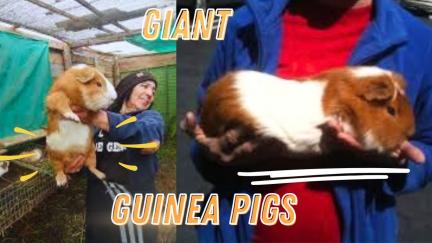
Cuy
- Most Cuy have coats like the Breed American, these GP are built and the size as they are in the wild. They are larger than other Breeds. As adults they weigh between 3 - 8 pounds.
"Cuy" is the word for Guinea Pig in South America where all Guinea Pigs got their start. They are bred for meat.
It is said that Cuy are more calm and snuggly than most other breeds. This and their size makes them a sought after pet, however, at this time the Cuy is a Rare Breed.
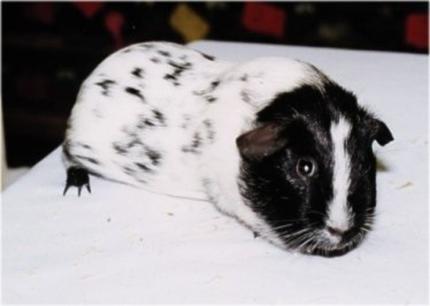
Dalmatian - Some people consider the Dalmatian Coloring and Markings a Breed, and they are in the UK, but Not in the USA. In the USA these GP are shown under the Breed American.
UK Standard For Perfection:
Points
Head, Eyes & Ears: Head to be of good size, bold and broad, with a gently curving profile. 15
Muzzle to be of good width and gently rounded at the nostrils.
Eyes to be large, bright and bold and set with good width between.
Ears to be large and drooping, and set with good width between.
Body Shape: To have short, cobby body with good width across shoulders and body. 10
To be fit and of good substance, with plenty of firm flesh.
To have good size appropriate to age.
Markings: 60
Head Markings: To have a white blaze with solid color on either side, giving a well balanced appearance. 20
Spotting: To have colored spotting on a white body; spots to be clear, distinct and well-distributed all over the body including belly. 30
Feet Markings: To have solid color covering the feet. 10
Color: Color to conform with ESCC, NACC or Argente Standards, as appropriate. 10
Eye color: also to conform to these standards, except for the Black whose eyes may have a ruby tint.
Coat: To be soft, clean and groomed free of guard hairs. 5
100
Colors: Dalmatians may be exhibited in any of the colors that are standardized for: Selfs, with the obvious exception of White, Agoutis or Argentes.
Dalmatians in Guide Standard Self or Ticked colors should also be regarded as having Guide Standards, with color/ticking features as for the relevant GS Cavy.
The Dalmatian is, in appearance, a white Cavy with colored markings. The color should be confined to the feet, head (with a central white blaze) and spotting, the latter to be evenly distributed throughout the body.
The distribution and clarity of spotting are of more importance than size, shape and quantity of spots. Spotting should be clear and distinct, with good demarcation between spots.
Large solid patches/areas of color are undesirable other than on the head and feet.
Roaned areas (patches of intermingled white and colored hairs) anywhere on the body are undesirable.
Intermittent white hairs on the head and/or feet do not constitute roaning but are still undesirable.
The head demarcation line (dividing the white body from the colored head) should follow the line of the head behind the ears and be clean-cut.
The blaze should begin at the nostrils and end at a point between the ears with no break in between. A blaze that runs through the mouth or through the demarcation line at the top of the head should be penalized.
The width of the blaze is immaterial as long as it is centrally placed between the eyes ears and has a balanced shape.
White whiskers are not a fault.
Whilst the eye color should generally conform to the relevant breed standard of the base color, dark eyes with a ruby tint should not be penalized.
Some Dalmatians with large eyes may have a blue/grey ring completely round the outer edge of the eye: this is not a fault.
Specific disqualifications:
Solid head
Incomplete blaze (blaze to appear complete without disturbance of coat)
Nails and/or foot pads deviating from the appropriate Self, Agouti or Argente standards
Specific faults:
The following faults are to be penalized according to extent:
Uneven Spotting
Roaning
Spinal Bar (a definite white line, lacking any form of spotting, and running the length of the spine from head to rump - usually found in more heavily marked exhibits)
Head Drag (solid color running on from the head through the demarcation line into the body)
Uneven or Offset Blaze
White hairs in otherwise solid colored areas on head and feet
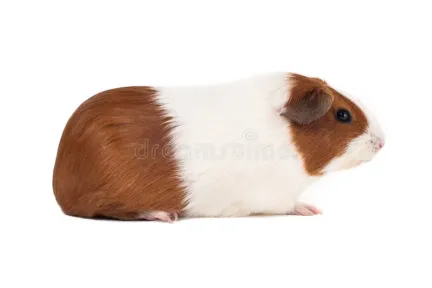
Dutch - Some people consider the Dutch Markings on a GP a Breed, as with rabbits, however, according to the American Cavy Breeders Association, these GP are show under the American Breed, Dutch Coloring.
These markings have been around for a lot of years, and YET, it is not easy to find a well, or correctly marked, Dutch Guinea Pig, in any of the breeds these Markings are excepted in.
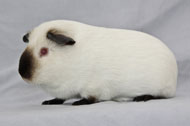
Himalayan - The Himalayan, unlike the Rabbit Breed, is not considered a Breed in the USA, but markings on an American Cavy with Siamese Cat markings. The coloring, white, with black points, nose, ears, feet and tail.
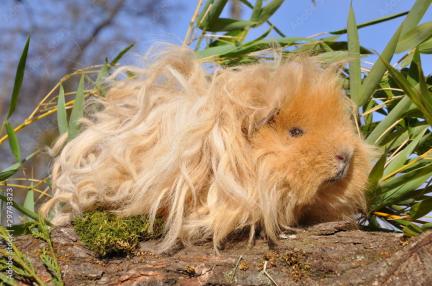
Lunkarya - The Lunkarya is a long-coated cavy with loose curls (not ringlets),frontal,cheek sweeps, and two rump rosettes.
TYPE–Points 15: Lunkaryas are to have a cobby body with well-developed shoulders, a strong midsection, and well-rounded,smooth hindquarters. Head to be broad with good width. Eyes to be large and bold.
COAT–Points 65: (Texture 25, Density 15, Structure 15, Head Furnishings; Cheek, Side, and Rear Sweeps 10).
Texture–Points 25: The texture of the coat is to be as harsh as possible giving it a good rise and elastic impression all over the body.
Density–Points 15: The density of the coat is to be even all around the body, from closest to the body and outwards to the tips.
Structure–Points 15: The coat is to have loose curls and waves, giving an unruly, tousled appearance. The belly coat should be dense and curly.
Head Furnishings; cheek, side, and rear sweeps–Points 10: The head furnishings are to cover the head when it is an adult forming a thick frontal. The coat on the head is shorter and with coarse wavy hairs standing straight out. The cheek sweeps which cover the cheeks and jawline should be pronounced and strong with hair all of one length. Two rump rosettes should be placed as far back as possible over the hips, lifting the coat toward the front of the animal. The coat of the sides should be even and harmonize with the overall length.
Faults–Additional rosettes, thin texture, lacking waviness, matted coat, breaks or gaps in the coat, uneven sweeps.
Disqualifications from Competition–No rump rosettes, totally straight coat with no curl or wave.
COLOR–Points 10: Color is to match the variety description. In marked varieties color points are to be divided equally – ½ the points
to color quality and ½ the points to markings.
CONDITION–Points 10: Per ARBA definition.
Eligible to be entered in all ARBA sanctioned shows as exhibition animals. May NOT compete for Best in Show.
Merino
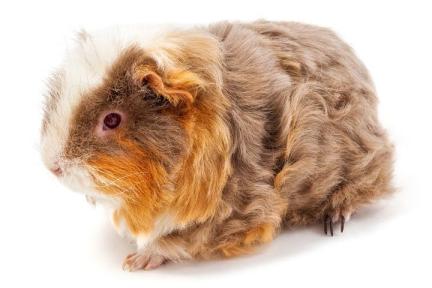
The Merino guinea pig (or alpaca guinea pig) generally has longer hair. This breed’s hair forms waves that sit tightly against the body. Their unique curls are highly reminiscent of their name sakes, merino wool or alpacas.
Merinos may have a rosette on their head that looks similar to the Crested guinea pigs’ trademark look. They come in a wide away of coat colors.
These GP need to be brushed out regularly.
Standard of Points
Head, Eyes, Ears & Coronet 20
Head to be of good size, bold and broad. Muzzle to be of good width and rounded at the nostrils. 10
Eyes to be large, bright and bold and set with good width between.
Ears to be large and drooping, and set with good width between.
Coronetto is to be a rosette on front of head, radiating from a pinpoint center, & to be well -formed and symmetrical with lower edge well down the nose. 10
Coat Appearance 30
Chops to be strong, even, dense and well-furnished, with no gaps.
Shoulders to have hair of appropriate length continuing evenly around sides.
Sweep to cover the hindquarters of the cavy and be full and of even length.
Generally the sweep will be a little longer than the sides.
Coat to be springy in appearance and show rexoid characteristics.
No breaks in coat, thin areas near the body or uneven length should be evident.
Coat Type 30
Coat Texture to be soft and springy, and free flowing over all areas of the body. 15
Coat Density to be full and dense in all areas when assessed nearer the body where the undercoat supports the top coat. 15
Belly to be curly, woolly and dense.
Presentation To be clean, free of grease and unmatted, with no resistance to a comb. 10
Body To have short, cobby body; thick-set, with good width across shoulders. 10
To be fit and of good substance, with plenty of firm flesh.
To have good size appropriate to age.
100
Specific requirements: The Cavy must be shown with a central parting, on a board of appropriate size, and covered in natural-colored hessian.
The hair on the face should lie pointing towards the rear of the cavy.
Guidance notes
The Merino rexoid, long-coated cavy with a crest, being the rexoid equivalent of the Coronet. As in all Longhairs coat qualities are paramount.
Coat length should be appropriate to the age of the cavy, a guideline being circa 2.5 cm (1 inch) per month of age.
Allowance should be made that the coat will appear thinner in older, longer coated exhibits because the undercoat does not attain the same length as the top coat, which is spread over a larger area.
Merinos may be shown in any color or mixture of colors.
Specific disqualifications: Rosettes other than the coronet
Specific faults: None
Rex - Basically the same Guinea Pig as a Teddy EXCEPT the Rex has a Soft Coat and the Teddy has more of a Wirery Coat.
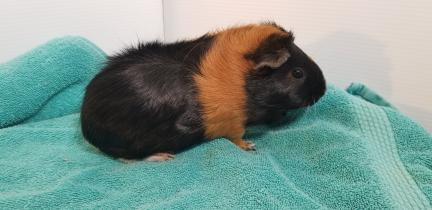
Ridgeback - A short haired breed with a Ridge on the spine of Standing Hair, think Mohawk.
This is a photo of my own Rigdeback, Guinevere.
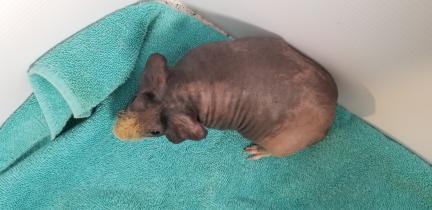
Skinny Pig - Hairless is the goal, but most have 'scraggly' hair on face and often, other places on their body. That hair is Teddy/Rex type hair.
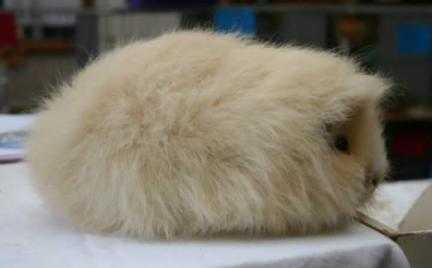
Swiss - Swiss Guinea Pigs are basically a Teddy with a Medium Length Coat.
Head, Eyes & Ears: Head to be of good size, bold & broad, Muzzle of good width & rounded at the nostrils. 15
Eyes to be large, bright and bold and set with good width between.
Ears to be large and drooping, and set with good width between.
Body Shape: To have short, cobby body; thick-set, with good width across shoulders. 15
To be fit and of good substance, with plenty of firm flesh.
To have good size appropriate to age.
Coat Appearance: To stand erect from the head and body with its slightly forward natural lie, being thick and even in length to give a round and plush overall (‘puff-ball’) appearance, with sufficient density that the skin is not visible without parting the coat. 30
There should be no tendency for a visible parting in the coat.
The length of the coat should be between 5cm and 10cm in length and be even across the shoulders, sides and back.
Chops should be strong, even, dense and well-furnished, with no gaps, to be known as facial furnishings.
Belly to be well-covered but with coat shorter in length than on the rest of the body.
Coat Type: The coat to be dense, plush and springy against the body, coarse enough to support the hair standing erect but soft enough to create the required ‘puffball’ appearance. 30
Presentation: To be presented clean, and free from tangles or matting. 10
Hair to stand erect (with natural forward lie) all over the body to create a full and rounded appearance with no tendency of parting.
Coat to be free from grease.
Coat to be capable of being combed easily from root to tip of coat.
100
NB: Any Full Standard for this breed is likely to be based on those for the Rough Longhair breeds.
Specific requirements:
Swiss may be shown in any color or combination of colors.
They must be shown on a board of appropriate size covered in natural-colored hessian, together with a comb.
Longer hairs, known as ‘horns’, over the ears to be penalized according to the extent of the fault.
The Swiss is a rexoid, semi-longhaired cavy whose coat stands erect from the body to give a rounded shape of even (‘puff-ball’) appearance.
To have a rounded coat shape and texture.
The Swiss is inclined to molt at regular intervals, from the shoulder backwards. Accordingly, those in ‘mid molt’ have longer coats around the rump than on the rest of the body. They should not be shown during the molting stages.
Some Swiss possess a rosette on the forehead. This usually fills out and disappears by 5 months of age. However, Swiss should not be shown with any visible rosette.
Allowance should be made for softer coat texture and shorter length in U/5 exhibits.
Specific disqualifications: None
Specific Faults: The presence of any visible rosette in the coat (usually found on the head) is a severe fault.
Having coat of inappropriate length, or of differing lengths and texture (particularly extra length on the rump), is a severe fault.
Coat faults, where the coat direction visibly goes against the general lie of the coat, such as swirls (usually found in the hip area), waves or curls should be penalized according to the extent of the fault.
Exhibits with coats exceeding 10cm in length.
Vampire or Devil or Black Devils
This unusual to rare Cavy coloration is now showing up as a Breed. What they are is a Ruby Eyed Black. Hopefully, I will have a photo before too long.
Call it what you will, it really IS a striking looking Cavy.
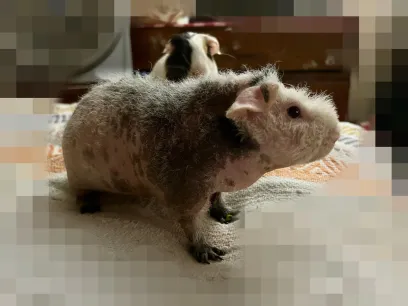
Wearwolf - This is a Skinny Pig with more hair, patches, they are very dark colored to black and should have Red/Ruby Eyes.
The idea is for the Cavy to look as if it is changing into a Wearwolf, mid transition, if you will.
-- The Small Animal Fun Team
Fri, 24 Jul 2026 15:12:00 +0000
| 



 In the high plains of South Dakota, USA